 TESKIS
Watering the right way: less water, greener garden
Why frequent shallow watering grows shallow roots, and how to water deeply and less often: soil checks, timings, litres per plant, mulch and heatwave rules.
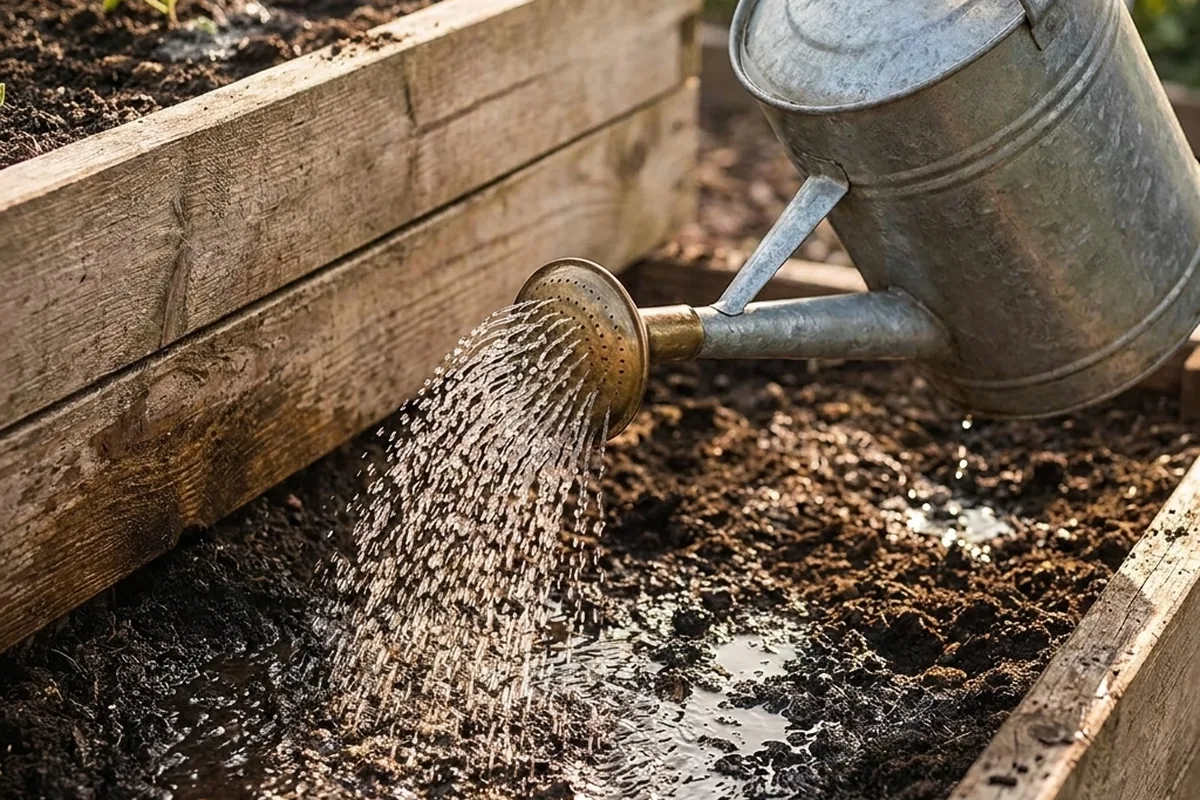
Most gardens are watered too often and not deeply enough. A short pass with the hose every evening feels diligent, but it keeps roots in the top few centimetres of soil, where the water lands and where the ground dries first. Water less often and far more thoroughly and roots follow the moisture down instead — and a deep-rooted garden gets through a dry fortnight without you.
Why little and often backfires
Five minutes with a hose over a border wets the top 10 to 15 millimetres of soil. On a warm, breezy day most of that is gone by mid-afternoon, and almost none of it reaches the depth where a shrub or a tomato feeds. Roots grow where the water is, so shallow watering keeps them in the top 5 centimetres — the hottest and driest layer in the garden. The plant then depends on you turning up daily, and the first day you do not, it wilts.
A deep soak reverses that. Wet the soil to 20 or 25 centimetres and roots follow the moisture into ground that stays damp for days. The plant that needed attention every evening in June will hold for a week in July.
Stop guessing: check the soil
Watering to a schedule waters the calendar, not the garden. Three checks take under a minute between them:
- Finger test. Push a finger in to the second knuckle, roughly 5 centimetres. Damp at the fingertip means wait.
- Trowel test. Dig a hole 15 to 20 centimetres deep at the edge of a bed and look at the side of it. It is the only check that shows what is happening at root depth.
- Screwdriver test. A 15-centimetre screwdriver slides to the handle in moist soil and stops within a few centimetres in dry soil.
- Weight, for pots. Learn what a container weighs an hour after watering and what it weighs dry, and you will not need to test the compost again.
One thing that is not a test: wilting at two in the afternoon. Courgettes, hydrangeas and most large-leaved plants flag in heat and recover by evening with no water at all. Judge at eight in the morning instead.
Water in the morning
Between 6am and 9am is the best window. The soil is cool, so water soaks in rather than evaporating off the surface; foliage dries within the hour, which keeps mildew and slugs down; and the plant meets the hottest part of the day with a full reserve. Evening is a reasonable second choice, but leaves stay wet overnight, which is how mildew gets into roses, phlox and courgettes. Either way, put the water on the soil at the base. Watering the leaves wets the one part of the plant that cannot drink.
How much, and where
One litre per square metre is the same as one millimetre of rain. That conversion makes every other figure legible.
| Situation | Wet the soil to | Typical volume | Dry-summer frequency |
|---|---|---|---|
| Established lawn | 15 cm | 15-20 litres per square metre | Once a week, or not at all |
| Established beds and shrubs | 25 cm | 10-15 litres per plant | Once a week |
| Vegetables in full crop | 20 cm | 15-20 litres per square metre | Twice a week |
| Perennials planted this year | 20 cm | 5 litres per plant | Twice a week |
| Trees and shrubs, first two summers | 30 cm | 20-30 litres per plant | Once or twice a week |
| Pots and containers | Until it runs from the drainage holes | 1-3 litres per 30 cm pot | Daily, twice in a heatwave |
Lawns
For most gardens the honest answer is to let the lawn go brown. Grass browning in August is dormant, not dead, and it greens up within two or three weeks of proper rain. If you do water it, water it properly: once a week, 15 to 20 litres per square metre. Stand a straight-sided tin under the sprinkler, run it until 15 millimetres has collected, and use that time as your setting. Raise the mower to 5 centimetres through a dry spell and hold off high-nitrogen feed until the rain returns.
Beds and borders
Deliver water slowly at the base so it travels down rather than sideways. A garden hose runs 10 to 15 litres a minute, so a minute at the foot of a shrub is roughly a full can. Aim at the ring of soil under the outer edge of the canopy, not the stem.
Pots
Containers play by different rules because the reservoir is fixed and small: daily in summer, twice on 30-degree days for anything in terracotta or under 25 centimetres across. Water until it runs from the drainage holes, wait two minutes, then water again — the first pass mostly wets the surface. If the compost has shrunk from the sides, water runs down the gap and straight out; stand the pot in a bucket for 20 minutes until the bubbles stop.
New plantings
Anything planted in the last two years has roots still largely inside the original rootball, so water onto the rootball itself rather than in a ring around it. For a new tree, sink a 30-centimetre length of pipe beside the roots at planting time: 25 litres down a pipe reaches depth, while 25 litres over the surface spreads and mostly evaporates.
Mulch, and the soil under it
Mulch is the cheapest watering equipment there is. Spread 5 to 7 centimetres of bark, garden compost or leaf mould over soil that has just been soaked, keeping it 5 centimetres clear of stems and trunks. It cuts surface evaporation, holds the root zone cooler and suppresses the weeds competing for the same water. Mulching dry soil seals the dryness in, so the order matters: soak first, mulch second.
Soil improvement is the change that compounds. Organic matter holds many times its own weight in water and works in both directions — clay drains better, sand holds on. A 5-centimetre layer of compost over the beds each autumn, left for the worms, does more for drought resilience over three years than any watering routine.
Kit that earns its place
- A 10-litre can with a fine rose for seedlings and the rose off for base watering. Filled it weighs 10 kilos, so two half-filled cans carry better than one full one.
- A hose with a lever gun on its lowest flow. Precision at the base beats a wide spray.
- Soaker hose laid along a row or through a border and covered with mulch. It seeps roughly 2 to 4 litres per metre per hour straight into the soil; 45 to 60 minutes, once or twice a week, does a whole border.
- A battery tap timer set for 6am, twice a week, on the soaker hose. The value is the consistency, not the automation.
Teskis stocks one tested option in each of these categories rather than a wall of near-identical variants, with flow rates and dimensions on the product page.
Heatwaves and hosepipe restrictions
When water is short, ration it in order: pots and baskets first, since they hold no reserve and die within days; then anything planted this year; then vegetables in crop; then established shrubs under real stress; and the lawn last, which in practice means not at all. Through a heatwave, water at first light only, move containers into afternoon shade, and postpone planting and feeding until the soil cools in September.
Where a restriction applies, a watering can is usually still permitted and timed drip or seep systems often are too, but the wording varies by region, so read the notice your supplier issues rather than assuming. Cooled washing-up and shower water suits ornamentals and lawns if it is used within a day and carries no bleach or dishwasher salt; keep it off anything you will eat raw. Rainwater is never restricted and collects faster than people expect: a 12-square-metre shed roof yields about 12 litres per millimetre of rain, so one 10-millimetre shower fills a 120-litre butt.
The short version
Check the soil at depth once a week instead of watering to a schedule. When it needs water, give it enough to wet the ground to 20 centimetres, then leave it alone. Morning, at the base, mulch afterwards.